'/%3E%3C/svg%3E)


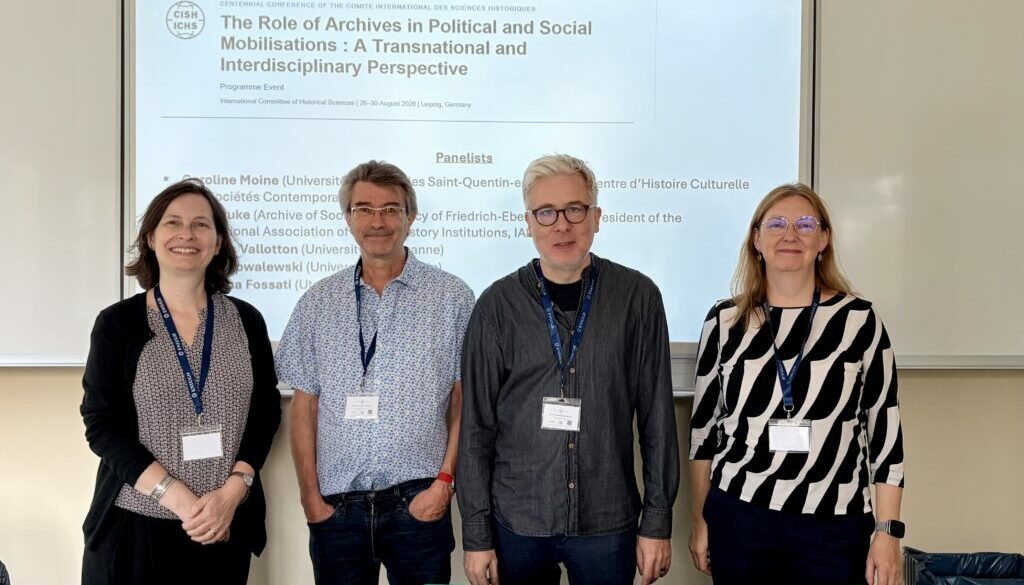
The Role of Archives in Political and Social Mobilization – a panel discussion at the CISH 2026
On August 28, 2026, together with colleagues from sister project ACTIVATE, we met in Leipzig to participate in a panel titled “The Role of Archives in Political and Social Mobilizations.” The panel was organized as part of the anniversary conference of the International Committee of Historical Sciences (Comité International des Sciences Historiques – CISH). From August 26–30, 2026, under the theme “The Past, Present, and Future of History”, the conference brought together over 700 speakers across 64 panels and 10 special events.
Convened by François Vallotton (Université de Lausanne), the panel brought together scholars and archival practitioners working across different national, disciplinary, and institutional contexts.
Caroline Moine ((Université de Versailles Saint-Quentin-en-Yvelines, Centre d’Histoire Culturelle des Sociétés Contemporaines) addressed the possibilities of studying archives not simply as repositories of historical evidence, but as resources that can be reactivated and reinterpreted across different historical and geographical settings. Anja Kruke (Archive of Social Democracy of the Friedrich-Ebert-Stiftung; President of the International Association of Labour History Institutions, IALHI) discussed “Material Culture in Social and Political Mobilisation,” drew attention to the importance of objects and material traces for understanding political engagement and the ways movements document themselves.
In his presentation, “For a History of Alternative Media in Europe from the 19th to the 21st Century: Theoretical and Archival Issues,” François Vallotton (Université de Lausanne) reflected on the methodological challenges involved in reconstructing the history of alternative media and their relationship with changing forms of political communication and mobilisation.
Giovanna Fossati (Utrecht University) sent her presentation on “Global Audiovisual Archiving: Fostering Collaboration and Rethinking Audiovisual Heritage,” extending the discussion towards audiovisual collections, international cooperation and changing approaches to the preservation and circulation of audiovisual heritage.
Finally, Maciej Kowalewski (University of Szczecin) presented “Archives of Social Movements and the Local Context,” focusing on the relationship between activist archives and the places and communities in which they operate. The presentation highlighted the importance of understanding archives as embedded in local networks of activists, institutions, memory practices and social relations rather than as isolated repositories of protest materials.